
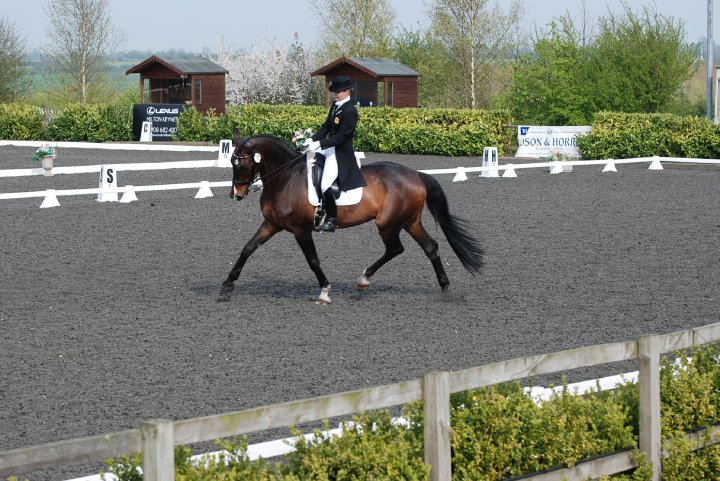
Suppleness is a very fluid term – is there a pun in there somewhere?! A rider has to bear in mind the difference between bend and flexion, and between lateral suppleness and longitudinal suppleness. Finally, it is important to remember that a supple youngster will not show the same abilities as a supple Grand Prix horse.
The longitudinal suppleness is often forgotten, but it is the next step up from the basic rhythm we were talking about last time. Another good term to use would be ‘swing’ – when a horse can swing its energy through from the hind leg to the bit, while maintaining a good rhythm, we can say that he is longitudinally supple. It is only when he can show this loose suppleness forward and to the bit that we can start to ride the contact. If we take the contact to soon, and ask for a shorter frame, the horse will not be supple and the rhythm will suffer. In order to achieve true longitudinal suppleness, the rider needs to think about riding forward in a secure rhythm to a soft but supportive rein. Of course, the young horse will be in a more horizontal balance than a trained horse, but the principal should remain the same. A key sign of suppleness that is often missed is the change of frame between collection and extension – if the horse does not open the frame when the rider asks for the extended paces, there is something missing in the suppleness.
The other way a horse can be supple is laterally – but this doesn’t just mean neck bend! The horse has to bend through his whole body, and make the shape of the turn through every vertebrae from his poll to his tail. Some horses offer lots of neck bend and the rider takes it, thinking he’s showing suppleness – it’s a trick! Usually, it is a way for the horse to push his weight onto the opposite shoulder and thus avoid activating his inside hind leg. If the rider wants true bend and suppleness, it needs to come from the acceptance of the inside leg, which pushes the horse across the diagonal line to the outside rein. Only then can the horse be truly supple.
Of course, like us, almost all horses are a bit one-sided. Whether that means they just lose a bit of balance to the left or it feels like they are pulling your right arm out of its socket (trust me, I’ve been there!), it is up to the rider to encourage the horse to take more contact on the softer rein, bring the balance more central, and lighten the heavier rein. There is very rarely a ‘quick fix’ but with careful and consistent work, the horse will become more even.
There are lots of useful exercises to improve suppleness, but one of my favourites is the basic leg-yield. It can be introduced early on in the training with very little stress and it is ridiculously useful for guiding the horse to the outside rein. Once the basic idea is established, it is really helpful to ride some variations. Going one way from the track to the middle, then the other way back to the track, can make a huge difference to a horse that is one-sided, while riding transitions within the trot in the leg-yield can encourage him to open the shoulder as he goes forward, then sit and cross behind when you bring him back. Playing around is the key and helps you avoid getting stuck on one circle with one contact.
To sum up, the suppleness is a natural progression from the initial work on the rhythm. If your horse is rhythmical, forward and swinging, you can start to improve the suppleness. This is really the first time we start to train the horse, strengthen his muscles and develop his physiology. It might seem like a very basic aspect but establishing the idea of suppleness early on will stand you in good stead as you progress up the levels.
Next week… Contact
1 thought on “Scales of Training – Suppleness”
Comments are closed.